
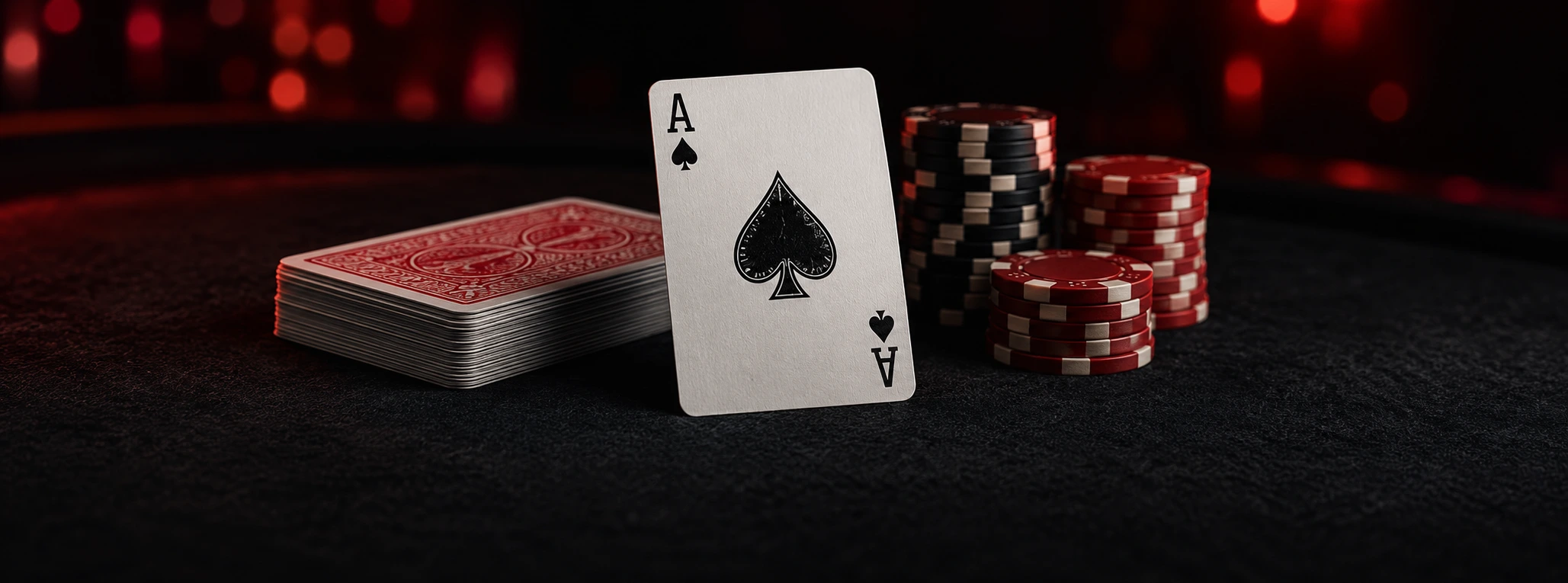
An ace rests against a stack of red-backed cards. Beside it, pale edges catch the light on a small tower of chips. The scene is quiet, yet it contains several of the images that make casino entertainment recognisable: a concealed face, a waiting table and an object about to move. Leon’s supplied brand description names casino games, live casino and slots. Those broad subjects offer different visual worlds, from the spare geometry of a card table to the crowded colour of a reel display.
This feature follows those worlds as entertainment themes. Imagine a fictional evening arranged as three scenes: first a card table, then a live-table view, and finally a row of mechanical reels. The setting is invented, with no claim to describe a visit or a particular Leon service. Its details give us a way to look closely at familiar objects and the different kinds of attention they invite.
The small theatre of a card
A playing card is an unusually economical prop. Its back withholds almost everything; its face announces a suit and a rank with a few marks. A single turned card can alter the appearance of an entire table. Red and black provide an immediate contrast, while the repetition of small symbols gives the pack its orderly character. Even before a game begins, the deck suggests that something remains concealed.
In our imagined scene, a lamp lights the card edges more strongly than the surrounding felt. The table has room to breathe. A hand entering this space becomes a visible event because there is so little competing movement. This is part of the appeal of card imagery: a modest gesture can carry the scene. A pause beside an unopened hand feels different from the bright finish of a completed display.
The cards also carry traces of physical use. Corners soften, surfaces reflect light at an angle, and the pack settles into a slightly uneven stack. These textures help a photograph hold interest after its main subject has been recognised. A stylised ace can work almost like a sign; a close view of paper grain makes the same object feel specific and tangible.
A table with people around it
Live-table presentation adds human movement to this spare arrangement. A face, a sleeve and the position of a hand introduce details that a still life cannot supply. The frame may stay in one place while small changes continue within it. A person looks down, objects are gathered, and an empty area of cloth becomes occupied again. The table acquires a visible routine.
That routine gives the scene its particular rhythm. Some moments are visually busy; others contain little movement. A viewer can notice the difference between an action happening on the table and the surrounding presentation that makes it easy to follow. Camera distance matters to the mood. A broad view gives the room a place in the picture, while a close view concentrates attention on hands and objects.
A wheel creates another centre of attention. Its circular shape contrasts with the rectangular cards and straight table edges nearby. Reflections travel around a polished rim, then settle as motion slows. The image is familiar even to someone who has never taken part. It belongs to the visual language of casino entertainment, where suspense often comes from watching an ordinary object complete a movement.
Reels and their bright vocabulary
The third scene begins with a red seven, a bell and a pair of cherries. Mechanical reel imagery has a directness that survives changes in fashion. Each symbol needs to be recognised quickly, so bold colour and a clear outline do much of the work. A metallic frame separates the symbols into neighbouring windows, giving the whole arrangement a compact, repeatable structure.
These objects have their own character. The bell suggests sound even in a silent image. The cherries bring an organic curve into a machine. The seven reads as a strong graphic shape, with its sloping stroke and flat top. Set beside one another, the symbols create a small collection of contrasts: metal and fruit, a numeral and a familiar household object, warm reflections and deep shadows.
Contemporary reel themes can fill the same basic space with an imagined landscape. Jewels, treasure chambers or comic characters give a display a setting and a cast. The artwork may hint at a story before any movement occurs. A richly coloured background creates a sense of place, while a repeated object keeps the image legible. Theme and presentation offer plenty to discuss without turning the scene into an explanation of how to play.
Three kinds of pace
Placed together, the scenes produce a varied evening of images. The card table draws attention to what is concealed. The live-table view brings a person’s gestures into the frame. The reels arrange recognition and movement inside a fixed structure. Their shared materials connect them, but each has a different visual tempo. A quiet card photograph can sit comfortably beside a much brighter reel picture.
Colour helps preserve that connection. Charcoal felt and cold silver leave room for restrained red highlights. Against this background, the white face of an ace becomes prominent without a large caption. Gold-toned reel frames introduce warmth farther along the scene. The change feels deliberate because the objects remain easy to identify and the darker surrounding space gives them a common setting.
At the end of the fictional evening, the cards return to their stack and the table is still again. What remains is a collection of memorable shapes: a spade, a circle, a seven and the narrow edge of a chip. These are the details that let casino imagery move between a photograph, a live view and an illustrated world while keeping its familiar character.